


CamVac
Knowledge Hub
-

CamVac Series
-

Made in Britain
-

Made in Sheffield
HVLP or HPLV
What Are the Differences and Why Do They Matter?
Two acronyms, four letters swapped – and a significant difference in what your extractor can actually do.
Key Takeaways
If you read nothing else, read these. They are the conclusions of this article – not teasers for what is coming.
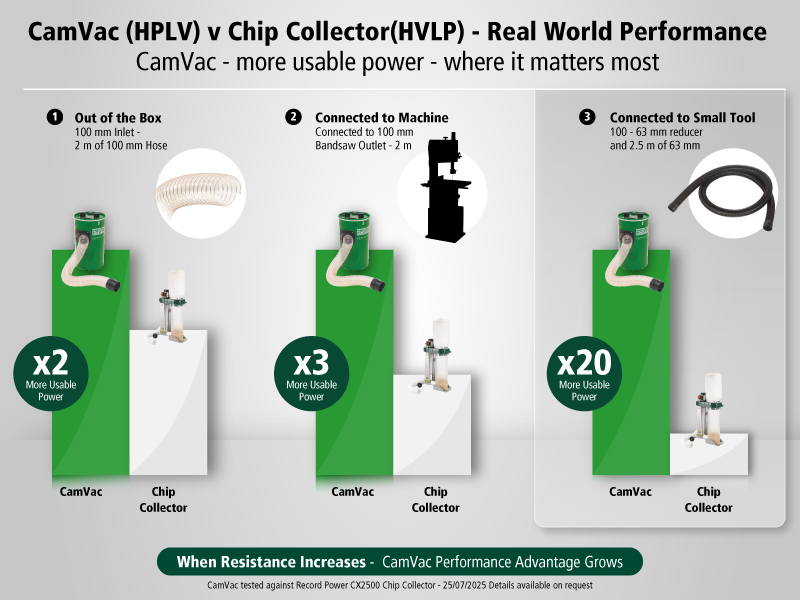
- HVLP (High Volume, Low Pressure) systems move large volumes of air – well suited to bulk chip collection, but offer limited protection for fine dust.
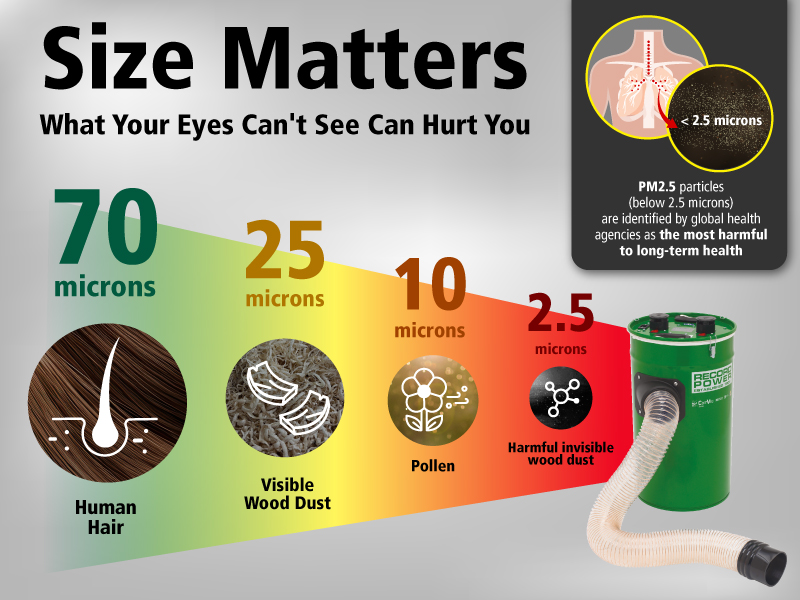
- HPLV (High Pressure, Low Volume) systems pull harder against resistance – which is what captures fine, health-threatening dust through a filter rated for efficiency in the PM2.5 range (identified by international governments and health agencies as the particle size range most hazardous to health).
- The type of extractor determines what it can capture and how it captures it. Size, price, and brand are secondary to this.
- A chip collector rated at high CFM may offer less real fine dust protection than a smaller HPLV system with lower CFM but higher pressure capable of driving a sub-micron filter efficiently.
- If you only have space for one extractor – most mixed workshops – with a variety of machines and tool types – are better served by an HPLV system than a traditional bag-type high airflow chip collector.
In Brief
HVLP and HPLV are similar looking – but they describe fundamentally different approaches to moving air and capturing dust. HVLP systems (High Volume, Low Pressure) are the traditional chip collector design: high airflow, wide hoses, effective for bulk waste but limited for fine particles. HPLV systems (High Pressure, Low Volume) work differently – they pull harder against resistance, maintaining suction through fine filters and narrow hoses. This usually makes them the more appropriate choice for fine dust control and meaningful health protection in most home workshops.
What This Article Covers
This article takes around five minutes to read in full. Use the links below to jump to any section.
- What Do HVLP and HPLV Stand For? – A clear definition before the detail
- HVLP: High Volume, Low Pressure – Strengths, limitations, and best applications
- HPLV: High Pressure, Low Volume – Strengths, limitations, and best applications
- Why Airflow Is Not the Whole Story – The spec that matters most for fine dust – and why it is often overlooked
- Which Should You Choose? – A practical decision framework by workshop type
- What About Compact Power Tool Extractors? – Where specialist extractors fit – and where they do not
- Common Questions – The questions we are asked most often
- Honest Limitations of This Article – What this article covers – and what it does not
- Further Reading – The companion articles that go deeper
What Do HVLP and HPLV Stand For?
Most traditional workshop dust extractors – particularly those with large impeller fans and filter bags – are HVLP systems, built around the principle of moving large volumes of air.
HVLP systems measure performance primarily in airflow (CFM – cubic feet per minute). In an open system with wide hoses and minimal resistance, they are effective at sweeping up large chips and coarse debris from machines like planers and jointers.
Strengths:
- Effective at collecting bulk chips and coarse dust from high-output machines.
- Compatible with wide hoses and open ductwork (100mm and above).
- Wide range of machines available at different price points.
Limitations:
- Struggle to maintain suction through narrow hoses or long duct runs – performance drops significantly with resistance.
- Poor at capturing fine, airborne dust – the kind that poses the most serious respiratory risk.
- Low static pressure means filter upgrades may reduce performance rather than improve it, as the system cannot drive air effectively through finer filter media.
HVLP systems can move a lot of air – but they cannot pull very hard. That distinction matters most when the goal is capturing fine dust through an efficient filter.
HPLV: High Pressure, Low Volume
HPLV systems are less common in woodworking but increasingly used where fine dust control and health protection are the priority.
Instead of moving large volumes of air, HPLV systems generate high static pressure – measured in inches of water lift or pascals. This pressure allows them to maintain suction through fine filters, narrow ducts, and long pipe runs where HVLP systems lose effectiveness.
Strengths:
- Maintain suction through fine sub-micron filters – capturing the particles most harmful to lungs.
- Effective with narrow hoses and long duct runs, where HVLP systems lose performance.
- Suitable for a wide range of machine types, including benchtop machines and handheld power tools.
- Generally more compact, as high-pressure filtration does not require the large filter surface area that HVLP systems need to maintain airflow.
Limitations:
- Lower raw airflow means they can be less effective for collecting large volumes of chips without multiple motors.
- Vacuum motors can run warm during extended use and may benefit from periodic rest in high-duty-cycle applications.
- Motor noise can be higher than some impeller-based systems, though quieter models and noise-reduction options exist.
Why Airflow Is Not the Whole Story
Airflow figures – quoted in CFM – are the most commonly cited performance metric, but for fine dust control, static pressure is the more relevant measure.
An HVLP extractor may quote 1,000 CFM. That figure is measured under open conditions – no filter resistance, no duct length, no tool restriction. Under the real conditions of workshop use, with fine filters and hose runs, that figure drops substantially.
An HPLV system might move only 200 CFM, but with sufficient static pressure to maintain that flow through a fine sub-micron filter and a three-metre hose run. In practice, it may capture significantly more of the dangerous fine dust than the higher-airflow machine.
The companion article on airflow covers this in detail, including the Air Watts measure that combines both airflow and pressure into a more useful single figure.
Which Should You Choose?
The right choice depends primarily on what your workshop produces and what your health protection priorities are.
HVLP may be the better fit if:
- Your primary need is removing large chips and shavings from high-output machines such as wide planers or jointers.
- Your duct runs are short and wide (120mm and above) with minimal bends.
- You are primarily concerned with workshop cleanliness rather than fine dust health protection.
HPLV is likely the better fit if:
- You want to capture fine dust at source – particularly from sanding, routing, turning, or sawing.
- Your workshop includes a mix of machine sizes and tool types.
- You are using or intend to use a filter rated for efficiency in the PM2.5 range (the range most associated with serious health risks).
- Long-term respiratory health is a priority.
For larger workshops with high chip output, a combination of both may be appropriate: HVLP for bulk chip collection from the largest machines, HPLV for fine dust and all other operations.
What About Compact Power Tool Extractors?
Compact HPLV extractors from premium power tool brands are well-suited to their intended use – but that use is narrower than their marketing sometimes suggests.
These machines offer good fine dust filtration and are designed to integrate with specific tool ranges – particularly sanders, routers, and other handheld power tools. For mobile use and on-site work, they perform well.
For general workshop use, their limitations become more relevant:
- Small filters and collection bins – effective for handheld tool use but prone to clogging quickly under machine-generated waste volumes.
- Narrow inlet diameters – optimised for small tool ports, not for the 100mm outlets on stationary machines.
- Single-motor designs – not readily scalable for extended or multi-tool use.
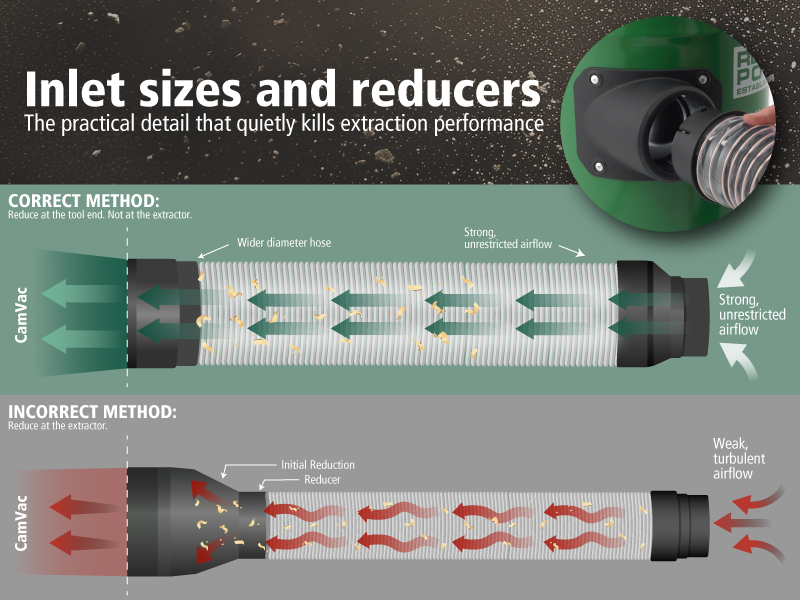
Larger HPLV systems with 100mm inlets – designed for fixed workshop use – can be reduced at the tool end to serve smaller outlets, maintaining the pressure advantage throughout. The companion article on inlet size and reducers covers this in detail.
Compact power tool extractors and workshop HPLV systems are both pressure-based – but they are optimised for different scales of use. Neither is a straightforward substitute for the other.
Common Questions
These are the questions we are asked most often.
I already have a chip collector – can I make it work for fine dust?
To some extent, with a cartridge filter upgrade. A good cartridge filter on a chip collector can improve filtration – reaching particles in the 1 to 5 micron range, which is better than a bag filter but still well short of meaningful PM2.5 protection. The deeper limitation is static pressure: if the machine does not generate enough pressure to drive air through a fine filter effectively, the upgrade may reduce airflow more than it improves filtration. A chip collector with a cartridge filter is a reasonable intermediate step, but it is not a like-for-like substitute for a purpose-built HPLV system for fine dust. The companion article Why Microns Matter covers what filter threshold ratings do and do not tell you about real-world performance.
Do I need both an HVLP and an HPLV system?
Not necessarily – it depends on your workshop. If you have a wide planer or jointer producing large chip volumes, a dedicated chip collector for that machine can make sense alongside an HPLV system for everything else. Many workshops manage well with a single well-chosen HPLV system, particularly if the HPLV machine has multi-motor options and interceptor options to handle higher chip loads. The key question is whether your primary extraction need is chip volume or fine dust control.
Why do so many workshops use HVLP systems if HPLV is better for fine dust?
HVLP systems have a long history in woodworking and are widely available at lower entry price points. They are also better understood – high airflow is easy to visualise and quote on a spec sheet. The health risks of fine dust have become better understood and more widely communicated over time, which is why HPLV systems are increasingly being chosen for health-focused workshops. Cost and familiarity have historically driven HVLP adoption; health awareness tends to drive the switch to HPLV.
CamVac is described as HPLV – does that mean it cannot handle chips?
CamVac’s pressure-based design means it handles fine dust more effectively than a chip collector of similar size. Multi-motor models can manage chip loads from a wider range of machines than a single-motor unit – and the cyclonic inlet helps separate larger debris before it reaches the filters. For very high chip volumes from wide planers running continuously, a dedicated chip collector may still be more appropriate. But for the typical mixed workshop, multi-motor CamVac models handle the full range well.
Honest Limitations of This Article
This article explains the HVLP and HPLV distinction. It does not cover airflow in detail, or how to set up your hose and reducer system.
The focus here is on the fundamental operating difference between the two system types and what that means for dust capture. Airflow measurement, static pressure, Air Watts, and hose configuration are each covered in dedicated companion articles. This article also does not cover respirators, ambient air filters, or personal protective equipment – all of which have a role in a layered dust protection approach.
Further Reading
Each of the following articles covers a specific aspect of dust extraction in depth. They are written to stand alone.
Understand the risk and the science:
> The Dangers of Wood Dust for Woodworkers – Why dust protection matters and what the health risks are.
> Why Microns Matter: Understanding Dust Filtration for Woodworkers – What particle sizes mean for your lungs, and what filter ratings actually measure.
Understand how your system performs:
> Airflow – Critical or Confusing? – Critical or Confusing? – Why CFM figures can be misleading – and what to look for instead.
>Inlet Size and Reducers – What Really Matters and Why – How hose diameter and reducer placement affect real extraction performance.
The complete guide:
> Dust Extraction Buyer’s Guide – A decision framework for choosing the right system for your workshop.

Discover more...
If you’ve enjoyed reading this guide, why not take a look at some of our blogs?