


CamVac
Knowledge Hub
-

CamVac Series
-

Made in Britain
-

Made in Sheffield
Dust Extraction Buyer’s Guide
Choosing the right system for your workshop – and how to avoid the most common pitfalls.

Key Takeaways
If you read nothing else, read these. They are the conclusions of this guide – not teasers for what is coming.
- Primary extraction at source is the most important layer – but only if the extractor is rated for the dust it needs to capture. A chip collector does not protect against fine dust. A vacuum extractor with an efficient filter does.
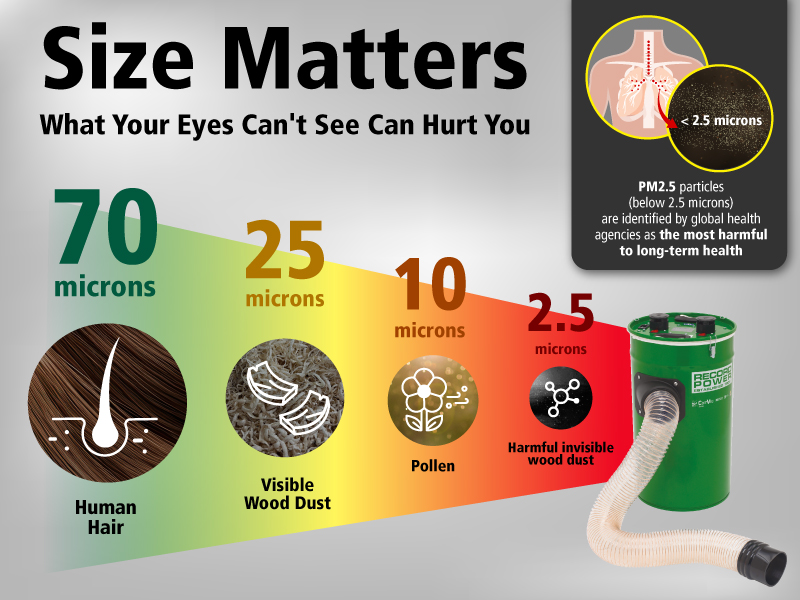
- PM2.5 – particles smaller than 2.5 microns – is the fraction identified by international health agencies as posing the greatest long-term risk. Filter efficiency in this range is the most meaningful measure of health protection.
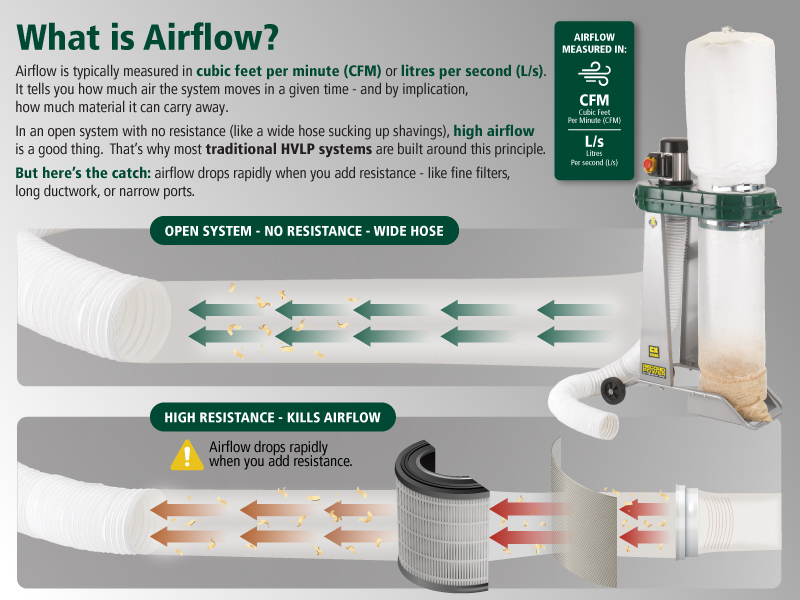
- Airflow figures on spec sheets are measured under open conditions. Static pressure determines real-world performance through filters and hoses. Do not compare systems on CFM alone.
- Most workshops benefit from a layered approach: primary extraction at source, ambient air filtration, and respiratory protection. Each addresses a different part of the problem.
- The right system depends on your tools, your workshop layout, and your health priorities – not on price or brand alone.
In Brief
Dust control isn’t one-size-fits-all. In fact, most well-designed workshops use a layered approach. Here is a breakdown of the three core systems – and what each does best.
- Effective dust extraction is one of the most important – and most misunderstood – investments a woodworker can make. It is about more than keeping the workshop tidy. The fine particles generated by sanding, routing, turning, and sawing are invisible, remain airborne for hours, and are associated with serious long-term health risks including respiratory disease and cancer. This guide walks through the three main strategies for dust control, explains what to look for in a primary extraction system, and provides a practical framework for matching a system to your workshop. By the end, you will understand not just what the options are – but which questions to ask before choosing between them.
What This Guide Covers
This guide takes around seven minutes to read in full. Use the links below to jump to any section.
- Why Dust Extraction Matters – The health case for taking extraction seriously
- Three Strategies for Dust Control – Primary extraction, ambient filtration, and personal protection
- What to Look for in a Primary Extractor – The key considerations and the most common traps
- Which System Suits Your Workshop? – A practical decision framework by workshop type
- Common Questions – The questions we are asked most often
- Honest Limitations of This Guide – What this guide covers – and what it does not
- Further Reading – The companion articles that go deeper on each topic
Why Dust Extraction Matters
Wood dust is not just a nuisance. It is a well-documented health risk – and the particles that cause the most lasting damage are the ones you cannot see.
The fine, invisible particles generated by sanding, routing, woodturning, and sawing remain suspended in workshop air long after work has stopped. Particles in the PM2.5 range – those smaller than 2.5 microns – are identified by the US EPA, the World Health Organization, and UK government agencies as the fraction posing the greatest long-term health risk. They are small enough to bypass the body’s natural defences and reach the deepest lung tissue, where clearance is very slow and cumulative exposure builds over years.
Wood dust is also classified as a Group 1 carcinogen by the International Agency for Research on Cancer (IARC), with the strongest evidence linking prolonged hardwood dust exposure to nasal and sinus cancers. And it is not only your health at stake – dust buildup inside machines affects performance, damages electronics, and reduces service life.
The particles settling visibly on your bench are not the ones posing the greatest long-term risk. The particles you cannot see – especially those below 2.5 microns – are the ones that reach deepest into lung tissue and are removed most slowly.
For a full explanation of the health risks and particle science, see The Dangers of Wood Dust for Woodworkers and Why Microns Matter.
Three Strategies for Dust Control
Dust control is not one-size-fits-all. Most well-designed workshops use a layered approach – combining systems that each address a different part of the problem.
1. Primary Extraction: Vacuum-Based Extractors (HPLV)
High Pressure, Low Volume systems use strong static pressure to capture fine dust at source. They are the preferred choice for health-focused dust control because they can maintain suction through fine filters and narrow hoses – the conditions needed to capture the particles most harmful to lungs.
Strengths:
- Effective at capturing fine dust from sanding, routing, turning, sawing, and benchtop machines.
- Maintain suction through fine filters and long hose runs where HVLP systems lose performance.
- Filter efficiency in the PM2.5 range is achievable – unlike bag and most cartridge filters.
- Compact design – high-pressure filtration does not require large filter surface area to maintain airflow.
- Modular motor options allow scaling for heavier applications or extended sessions.
Limitations:
- Lower raw airflow than HVLP systems – may need multiple motors for sustained heavy chip collection.
- Vacuum motors can run warm in high-duty-cycle applications and may benefit from periodic rest.
Compact Power Tool Extractors
Compact HPLV units from premium power tool brands offer good fine dust filtration and are designed to integrate with specific tool ranges. For mobile and on-site use with handheld power tools, they perform well.
For general workshop use, their limitations become more relevant:
- Small filter and bin capacity – effective for sanding and trimming, but prone to clogging under machine-generated waste volumes.
- Narrow native inlets – optimised for handheld tool ports, not for the 100mm outlets on stationary machines. No upstream adapter can compensate for a small inlet.
- Single-motor designs – not readily scalable for extended or multi-machine use.
Compact power tool extractors and workshop HPLV systems are both pressure-based – but they are optimised for different scales of use. Neither is a straightforward substitute for the other.
Chip Collectors (HVLP)
High Volume, Low Pressure systems move large volumes of air at low pressure, making them well suited to removing chips from high-output machines like planer-thicknessers and jointers.
Strengths:
- Effective for high-volume chip waste from wide-board planing and jointing.
- Wide-bore connections suit the large outlets on high-output machines.
- Lower entry cost in basic configurations.
Limitations:
- Standard bag filters do not capture fine dust in the PM2.5 range – the particles most associated with long-term health risk.
- Cartridge filter upgrades improve threshold ratings but efficiency in the PM2.5 range remains limited – and those filters are large, expensive, and still rarely approach the performance of a purpose-built vacuum extractor for fine dust.
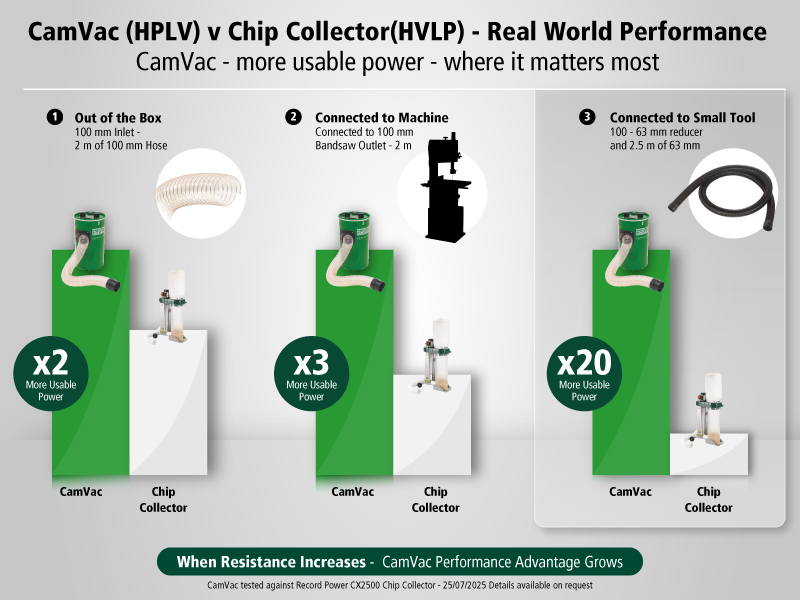
- Low static pressure means performance drops significantly through fine filters, narrow hoses, or long duct runs.
- Large footprint.
2. Secondary Support: Ambient Air Filters
Ceiling- or wall-mounted air filters cycle workshop air continuously, capturing fine particles that remain airborne despite primary extraction. They are particularly valuable for clearing the air after work has stopped – fine particles can remain suspended for hours.
Strengths:
- Help clean the air during and after work sessions.
- Low maintenance and unobtrusive when well-positioned.
- Useful for shared or enclosed spaces where airborne particles accumulate.
Limitations:
- Do not capture dust at source – a complement to primary extraction, not a substitute.
- Do not protect machines from dust buildup.
- Filtration quality and airflow capacity vary significantly between products.
When choosing an ambient air filter, look for one rated to capture particles in the PM2.5 range and with sufficient airflow to cycle the workshop volume meaningfully. Timer and remote control functions are genuinely useful – they allow the filter to continue running after you leave the workshop, clearing the fine particles that settle slowest. But effective filtration in the PM2.5 range is the primary consideration
3.Personal Protection: Respirators and Air-Fed Masks
PPE is your last line of defence – particularly valuable during sanding, working with known hazardous or sensitising species, cleaning machines, or emptying collected dust.
Strengths:
- Highest direct personal protection when worn correctly and consistently.
- FFP2/FFP3 half-masks are affordable entry points for effective fine dust protection.
- Air-fed systems provide face and eye protection alongside respiratory protection.
Limitations:
- Protects only the wearer, and only while being worn.
- Does not reduce workshop dust or protect machines.
- Comfort and fit issues reduce compliance – particularly with glasses.
- Air-fed systems can cost more than a primary extractor.
PPE provides the best personal protection – but only while it is being worn. It is most effective as part of a layered approach, not as the primary or only measure.
The Layered Approach in Practice
Most workshops benefit from combining all three layers. The table below shows which solution addresses which type of dust risk.
Dust type or risk | Primary solution | Supporting layer |
Fine dust from sanding, routing, turning, sawing | HPLV vacuum extractor with filter efficient in PM2.5 range | FFP2/FFP3 respirator for high-risk operations |
Chips from planers and jointers | HVLP chip collector (cartridge filter preferred) | Ambient air filter to catch fine fraction |
Residual airborne fine dust | Ambient air filter – run during and after sessions | Primary extraction reduces the load at source |
Direct user protection in high-risk tasks | FFP2/FFP3 respirator or air-fed mask | Primary extraction reduces concentration |
Machine cleaning and dust disposal | FFP2/FFP3 respirator – disturbing settled dust is high exposure risk | Extractors with disposable bag or collection options are a benefit here |
What to Look for in a Primary Extractor
Primary extractors are the backbone of any dust control strategy. Choosing the wrong type – or the right type with the wrong specification – is the most common and consequential mistake in workshop dust control.
Key considerations:
Filter efficiency in the PM2.5 range. This is the most important single measure of health protection. A filter’s nominal threshold rating – the smallest particle size it is designed to address – is not the same as its efficiency at that size under real operating conditions. It is useful as a directional comparator when there is no more information available (a 0.5 rated filter will likely protect you better against harmful dust than a 10 micron rated one). But look for systems where efficiency data in the PM2.5 range is available, not just threshold claims. See Why Microns Matter for a full explanation of what filter ratings do and do not tell you.
Static pressure, not just airflow. Airflow figures are generally measured under open conditions – no filter, no hose, no resistance. Static pressure can determine whether suction is maintained through real workshop conditions. For fine dust work, pressure is the more relevant measure. See Airflow – Critical or Confusing?
Inlet size and reduction strategy. The inlet sets the airflow ceiling for the whole system. Reduce at the tool end, not at the extractor inlet. A large-inlet machine stepped down gradually to a small tool port maintains performance throughout. See Inlet Size and Reducers – What Really Matters and Why.
Tool compatibility. Match the extractor to your tool types. A wide planer has different extraction needs from a palm sander or a router table.
Practical usability. A system that is quiet enough to use comfortably, easy to empty, and simple to move or position will be used consistently. Systems that clog frequently or require constant filter changes tend to be used less – reducing their protective value.
Upgrade paths. Can the system grow with your needs? Additional motors, interceptors, hoses, and accessories can extend a well-designed system significantly.
Common pitfalls to avoid :
- Trusting airflow ratings without context. High CFM figures are measured under ideal conditions. They say little about performance through filters and hoses. See Airflow – Critical or Confusing?
- Buying a chip collector for fine dust protection. Material bag filters on the exhaust side of chip collectors offer no meaningful PM2.5 protection. Cartridge filter upgrades help at the upper end of the range but rarely approach the efficiency of a purpose-built HPLV system in the range that matters most. See Why Microns Matter.
- Choking the inlet with severe reductions. Reducing from 100mm to 32mm at the extractor inlet restricts the whole system before airflow enters the hose. Reduce only at the tool end. See Inlet Size and Reducers.
- Assuming louder or larger means more powerful. System design, filter configuration, and static pressure determine real-world extraction performance – not motor noise or physical size.
- Underestimating the total cost of ownership. A lower entry price may not account for the cost of cartridge filter upgrades needed to reach adequate fine dust performance – or the additional footprint those upgrades require. And in many cases the high airflow chip collector extractors with no meaningful pressure are simply not capable of driving fine filters to the level required.
Which System Suits Your Workshop?
The right extractor depends on your primary tools, your workshop layout, and what you are most trying to protect against. The table below provides a practical starting point.
Workshop type | Best primary option | Notes |
Site or mobile use with handheld power tools | Compact power tool extractor | Optimised for portability and handheld tool integration |
Dedicated planing and jointing – chips only | HVLP chip collector with cartridge filter | Cartridge filter preferred over bag for improved fine dust capture at upper PM range |
Mixed workshop: routers, saws, sanders, benchtop machines | Workshop HPLV extractor (e.g. CamVac) | Fine dust control, adaptable to varied tool types, scalable with motors and accessories |
Growing workshop with varied and changing needs | Modular HPLV system | Flexible motor configuration, interceptor options, wide accessory range |
Large workshop with high chip output and fine dust tools | HVLP chip collector + HPLV vacuum extractor | Each handles what it does best – chip volume and fine dust respectively |
Common Questions
These are the questions we are asked most often.
I have a chip collector already – do I need to replace it?
Not necessarily, but it depends on what you are using it for. For high-volume chip collection from a wide planer or jointer, a chip collector remains an appropriate tool. For fine dust from sanding, routing, or turning – or for any work where long-term respiratory protection is a priority – a chip collector with a bag filter does not provide meaningful PM2.5 protection. A cartridge filter upgrade can improve performance at the upper end of the PM range, but is not a like-for-like substitute for a purpose-built HPLV system for fine dust. The practical question is whether your primary concern is chip volume, fine dust health protection, or both.
Can one extractor do everything?
For many workshops, yes – particularly if the primary work involves a mix of machine types rather than sustained heavy chip production. A well-specified HPLV system with multiple motor options can handle fine dust from sanding and routing as well as moderate chip loads from bandsaws, table saws, and benchtop machines. For workshops with very high chip volumes from wide planer-thicknessers running continuously, a dedicated chip collector for that machine alongside an HPLV system for everything else is a common and practical arrangement.
How important is the ambient air filter if I already have a good primary extractor?
A good primary extractor captures the majority of dust at source – which is where the problem should ideally be addressed. But some fine particles inevitably become airborne during any operation, and some tasks – particularly turning and hand sanding – are difficult to extract from directly. An ambient air filter addresses the residual fine dust that remains suspended after primary extraction. For workshops used regularly or for extended periods, it provides a meaningful additional layer of protection. It is also the most effective way to clear the air after a session before it is occupied again.
What is the most common mistake people make when buying a dust extractor?
Choosing based on airflow figures without considering static pressure or filter efficiency. A high CFM number is easy to quote on a spec sheet and easy to compare – but it is usually measured under open conditions that do not reflect real workshop use. The combination of static pressure, filter efficiency in the PM2.5 range, and inlet size relative to your tools is a much better guide to real-world performance. The second most common mistake is buying a chip collector for fine dust work and expecting it to provide lung-level protection.
Is it worth spending more on a higher-specified system?
The most useful comparison is not entry price but total cost of effective performance. A chip collector that requires a large cartridge filter upgrade to approach adequate fine dust protection may cost more overall than a purpose-built HPLV system that provides that protection as standard – while also taking up more space and still not matching the HPLV system’s efficiency in the PM2.5 range. For fine dust protection, the additional investment in a well-specified primary system tends to deliver better value than buying cheap and trying to upgrade later with diminishing returns.
Honest Limitations of This Guide
This guide provides a framework for understanding the main extraction options and making a more informed choice. It does not cover every product on the market or every workshop configuration.
The comparison tables are intended as starting points, not definitive recommendations. Every workshop is different – in tool mix, layout, budget, and usage patterns – and the right system is ultimately the one that fits your specific situation. For personalised guidance, your local Record Power dealer can advise on the most appropriate configuration for your tools and space.
This guide also does not cover fixed multi-machine duct systems in detail, MDF or composite materials (which carry additional hazards from binders and adhesives), or respiratory protection beyond the broad FFP2/FFP3 guidance. For workplace regulatory guidance, the HSE’s COSHH documentation is the appropriate reference.
Where CamVac Fits In
CamVac is designed for the mixed workshop – combining HPLV pressure performance with the capacity and scalability that workshop use demands.
For small to medium workshops with a variety of machines and tool types, CamVac offers a combination that is difficult to find elsewhere at a similar price point: genuine fine dust efficiency at the PM2.5 range as standard, multi-motor scalability, cyclonic inlet separation to protect filters and maintain consistent performance, and the flexibility to serve both handheld tools and floor-standing machines through graduated hose reduction.
CamVac is not the right choice for every situation. For continuous heavy planing of wide boards, a dedicated high-volume chip collector remains more appropriate for that specific load. For ultra-compact on-site use with handheld tools only, a compact power tool extractor is better suited. And for workshops already well-served by a large fixed HVLP ducted system, a separate HPLV system may not be necessary.
For a detailed look at what CamVac offers and where it performs best, see Is CamVac the Perfect Extractor for the Average Workshop?
Further Reading
Each of the following articles covers a specific topic in depth. They are written to stand alone and can be read in any order.
Understand the health risks:
> The Dangers of Wood Dust for Woodworkers – Why dust protection matters and what the health evidence says.
> Why Microns Matter: Understanding Dust Filtration for Woodworkers – What filter ratings actually measure, and what efficiency in the PM2.5 range means in practice.
Understand how extractors work:
> HVLP or HPLV – What Are the Differences and Why Do They Matter? – The extractor type question that determines what dust your machine can actually capture.
> Airflow – Critical or Confusing? – Why the CFM figure on a spec sheet may not reflect real-world performance.
> Inlet Size and Reducers – What Really Matters and Why – How hose setup affects what your extractor can actually capture.
Go deeper on CamVac:
> Is CamVac the Perfect Extractor for the Average Workshop? – A detailed look at what CamVac offers and where it performs best.
Want Personalised Advice?
Every workshop is different – and the best extractor is the one that fits yours. For personalised advice on the most appropriate system for your tools, space, and budget, contact your local Record Power dealer.

Discover more...
If you’ve enjoyed reading this guide, why not take a look at some of our blogs?