Powerful. Quiet. Compact. UK-Made. And Designed to Protect What Matters.
Whether you’re just exploring dust extraction or already comparing systems, CamVac offers something unique: a professional-grade, sub-micron filtered vacuum system trusted by thousands of woodworkers in over 30 countries.
Dust Extraction Buyer’s Guide
This page helps you understand:
- Why primary dust extraction matters
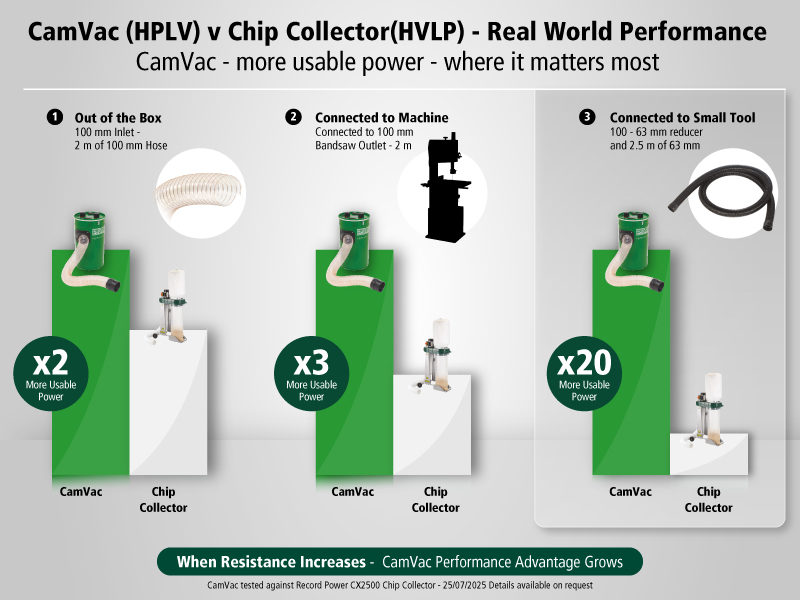
- How CamVac compares to typical shop vacs and chip collectors
- Which CamVac model might suit your workshop best
Why consider CamVac:
- Sub-micron filtration are standard – no costly upgrades needed
- Powerful suction for fine dust, small ports, long runs
- Multiple motor options to suit any size workshop
- Quieter than most extractors – with further reduction options
- UK made in our own production facility.
Is CamVac the Perfect Extractor for the Average Workshop?
Why Dust Extraction Matters:
Wood dust isn’t just messy – it’s hazardous. Fine, invisible dust from sanding and routing can stay airborne for hours, reaching deep into the lungs and potentially causing long-term respiratory issues. It also damages machines over time.
Why Microns Matter
The Dangers of Wood Dust for Woodworkers
What Makes CamVac Different?:
Most extractors fall into two categories:
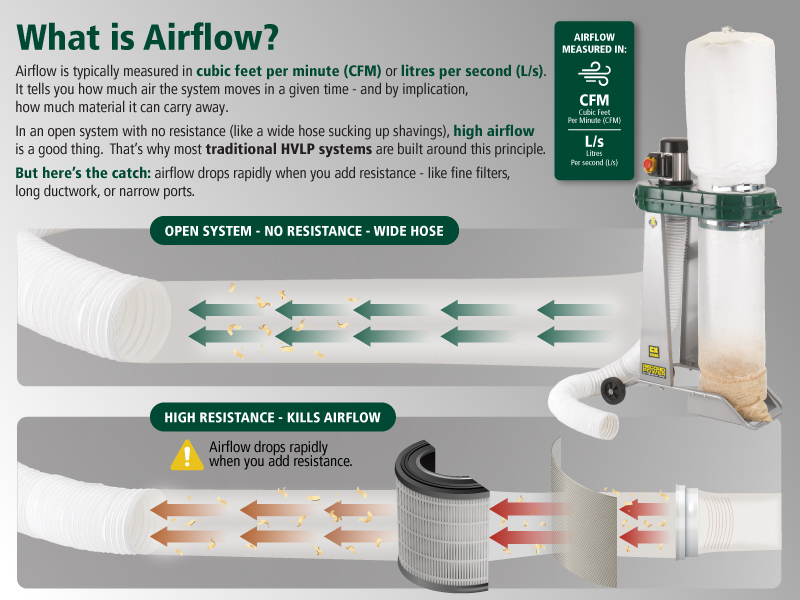
- HVLP Chip Collectors – great for big shavings, poor for fine dust
- HPLV Vacuum Systems – potentially more versatile – depending on machine choice
HVLP or HPLV – What Are the Differences and Why Do They Matter?
Airflow – Critical or Confusing?
Inlet Size and Reducers – What Really Matters and Why
CamVac is a hybrid system that combines the best of both worlds.
- Maintains suction through small hoses, fine filters and long ducting
- Uses sub-micron filters – standard, not optional
- Multiple sizes and motor options available to cover virtually any workshop setup
- Lower noise levels than many other extraction options
Is CamVac the Perfect Extractor for the Average Workshop?
Which CamVac Is Right for You?
The following table makes it easy to select the best CamVac model for you whether your priority is collection capacity or motor power:
CamVac Models – By Capacity and Power | Single Motor (1.1kw / 1.5 HP) | Twin Motor (2.2kw / 3 HP) | Triple Motor (3.3kw / 4.5 HP) |
Small Drum (36ltr / 10 gal) | CGV286-3 | CGV286-4 | n/a |
Medium Drum (55ltr / 15 gal) | CGV336-3 | CGV336-4 | n/a |
Large Drum (90ltr / 24 gal) | n/a | CGV386-5 | CGV386-6 |
Bag Collection (150ltr / 40 gal) | n/a | CGV286-3-WALL | n/a |
Extra Large Drum (200 ltr / 53 gal) | n/a | n/a | CGV486-6 |
Remember that for small, medium and large drum models – capacity can be increased by the addition of a CamVac Defender Interceptor
Defender Interceptors – By Capacity Collection Type and Mounting Options | Floorstanding | Wallmounted |
104960 Defender Interceptor – 55ltr / 15 gal Drum | Yes | n/a |
104970 Defender Interceptor – 150 ltr / 40 gal Bag | With optional 104950 Floorstand | Yes |
The following table shows which of the most popular accessories are available for each model:
Compatible Accessories Available | CVA286-27-100 Wheelkit | CVA-27-100 Wheelkit | CVA486-27-100 Wheelkit | 104950 FloorStand | 104960 Defender Interceptor – 55ltr / 15 gal | 104970 Defender Interceptor – 150ltr / 40 gal |
CGV286-3, CGV286-4, CGV336-3, CGV336-4 | Yes | n/a | n/a | n/a | Yes | Yes |
CGV386-5, CGV386-6 | n/a | Yes | n/a | n/a | Yes | Yes |
CGV286-3-WALL | n/a | n/a | n/a | Yes | Yes | Yes |
CGV486-6 | n/a | n/a | Yes | n/a | Yes | Yes |
Shop with Confidence
CamVac is made in the UK by Record Power – a trusted name in woodworking machinery with roots back to 1909 and beyond. With over a century of engineering expertise and real-world testing, we design tools that work hard, last long, and make your workshop better.
Protect your lungs. Protect your tools. Choose CamVac.
Want to learn more?
Dust Extraction Buyer’s Guide
Is CamVac the Perfect Extractor for the Average Workshop?
Why Microns Matter
Airflow – Critical or Confusing?
HVLP or HPLV – What Are the Differences and Why Do They Matter?
Inlet Size and Reducers – What Really Matters and Why
The Dangers of Wood Dust for Woodworkers