


CamVac
Knowledge Hub
-

CamVac Series
-

Made in Britain
-

Made in Sheffield
The Dangers of Wood Dust for Woodworkers
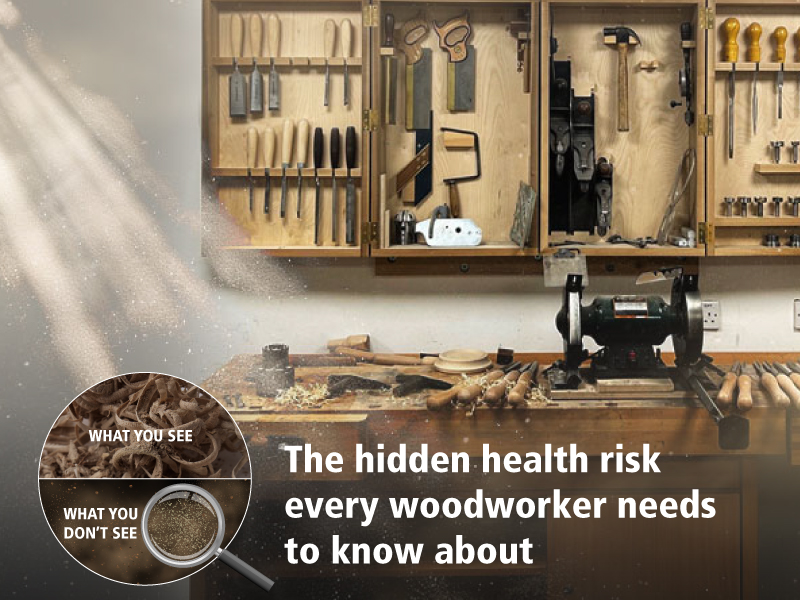
Wood dust is a well-documented health risk – and the most dangerous particles are the ones you cannot see.
Key Takeaways
If you read nothing else, read these. They are the conclusions of this article – not teasers for what is coming.
- For reference, a micron is one-thousandth of a millimetre.
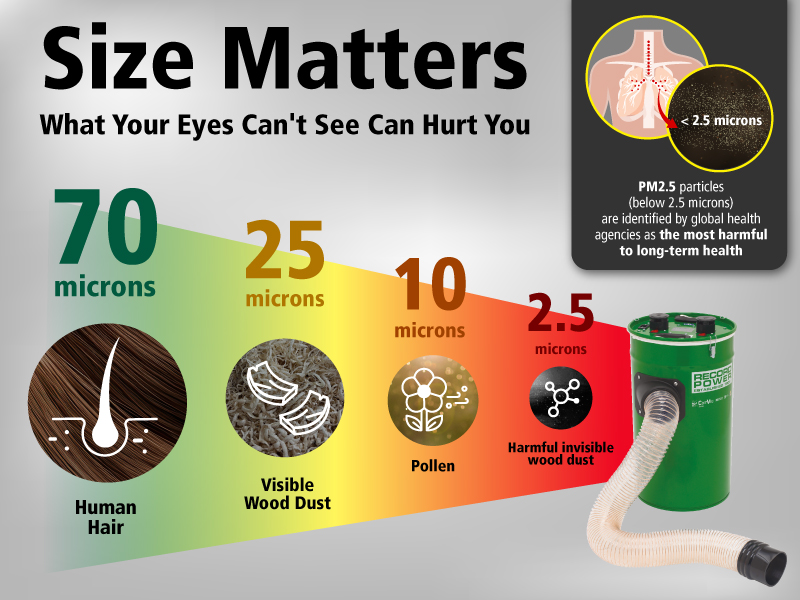
- The dust that poses the greatest long-term risk is invisible. Particles smaller than around 20 microns cannot be seen under normal workshop conditions.
- PM2.5 – particles smaller than 2.5 microns – has been identified by the US EPA, the World Health Organization and UK government agencies as the most dangerous fraction of airborne particulate matter for long-term health because it bypasses the body’s natural defences, can penetrate into the deepest parts of the lung and remain there accumulating over time.
- Wood dust is classified as a Group 1 carcinogen by the International Agency for Research on Cancer (IARC). The strongest evidence links prolonged hardwood dust exposure to nasal and paranasal sinus cancers.
- The health risk is not limited to industrial settings. Home workshops and small garages can present higher exposure risk than commercial premises, due to limited ventilation and the absence of formal dust control measures.
- Dust extraction, ambient air filtration, and respiratory protection each play a different role. For most workshops, the most effective approach combines all three.
In Brief
Wood dust is one of the most extensively studied occupational health hazards in manufacturing and craft industries. The particles of greatest concern are not the visible dust that settles on surfaces – they are the fine and ultrafine particles generated by sanding, routing, sawing and turning, which remain suspended in workshop air for hours. Particles in the PM2.5 range are small enough to bypass the body’s natural defences and reach the deepest lung tissue, where clearance is very slow and cumulative exposure builds over years. Most common bag filters, especially those used on high airflow machines as the final filter, offer no meaningful protection in this range. Understanding what the research says – and what equipment choices follow from it – is one of the most useful things a woodworker can do.
What This Article Covers
This article takes around five minutes to read in full. Use the links below to jump to any section.
- Health Conditions Linked to Wood Dust Exposure – What the research and regulatory bodies say about long-term risk
- Why the Risk Is Not Just Industrial – The particular exposure risks of small workshops and home garages
- The Fine Dust You Cannot See – How the most dangerous particles behave in a workshop environment
- A Practical Approach to Reducing Exposure – The layered protection model and where to start
- Frequently Asked Questions – The questions we are asked most often
- Honest Limitations of This Article – What this article covers – and what it does not
- Further Reading – The companion articles that go deeper
Health Conditions Linked to Wood Dust Exposure
Scientific and regulatory bodies in the UK, Europe, and the United States have linked wood dust exposure – particularly prolonged exposure to fine hardwood dust – to a range of serious health conditions.
The conditions most consistently associated with wood dust exposure include:
Respiratory conditions
- Occupational asthma – wood dust is one of the most common causes of work-related asthma in the UK
- Chronic bronchitis and airway inflammation from sustained exposure
- COPD (Chronic Obstructive Pulmonary Disease) in those with long-term high exposure
- Allergic reactions, particularly from species including western red cedar, iroko, and rosewood
Cancer risk
Wood dust is classified as a Group 1 carcinogen by the International Agency for Research on Cancer (IARC) – meaning there is sufficient evidence that it causes cancer in humans. The strongest association is with cancers of the nasal cavity and paranasal sinuses, particularly in those with prolonged hardwood dust exposure.
International Agency for Research on Cancer (IARC):
Wood dust is classified as a Group 1 carcinogen, with the strongest evidence linking prolonged hardwood dust exposure to nasal and paranasal sinus cancers.
[IARC Monographs on the Evaluation of Carcinogenic Risks to Humans, Volume 62, 1995]
Other health effects
- Skin and eye irritation, particularly from saps, resins, and fine dust from reactive species
- Sensitisation to specific wood species, which can develop over time and lead to increasingly severe reactions
Regulatory position in the UK
- In the UK, the Health and Safety Executive (HSE) sets a Workplace Exposure Limit (WEL) for wood dust and provides guidance under COSHH regulations (Control of Substances Hazardous to Health). COSHH places a legal duty on employers and the self-employed working commercially to control exposure – it does not apply directly to home hobbyists, though the underlying health risks are identical regardless of setting.
Health and Safety Executive (HSE) UK:
“ Hardwood dust can cause a rare form of nasal cancer. As well as causing asthma, wood dust, sap and the lichens associated with wood can have adverse health effects on the skin, respiratory tract (nose and lungs), eyes as well as the whole body.”
Why the Risk Is Not Just Industrial
It is a persistent assumption that serious dust-related health risks are primarily a problem for factory workers and professional woodworkers – but the evidence suggests home workshops can present comparable or higher exposure levels.
The reasons are practical rather than surprising. Commercial premises generally operate under COSHH requirements, with LEV (Local Exhaust Ventilation) systems, regular risk assessments, and dust monitoring. Small workshops and home garages typically have none of these. Ventilation is often limited. Extraction equipment, where present, may not be rated for fine dust. And the person working is frequently alone in the space, in close proximity to the source, with limited awareness of how long fine particles remain suspended after work stops.
Even brief sanding or routing sessions in a poorly ventilated space can produce fine particle concentrations significantly above those encountered in clean outdoor air. The cumulative effect of regular workshop sessions – over months and years – is where the long-term risk accumulates.
The most dangerous dust in your workshop is the dust you cannot see – and in a home workshop without effective fine dust extraction, that dust may be present in far greater concentrations than most woodworkers assume.
The Fine Dust You Cannot See
Fine particles – those in the PM2.5 range and below – behave differently from visible dust in ways that make them harder to avoid and harder for the body to clear.
Where coarser particles settle relatively quickly onto surfaces, fine particles can remain suspended in workshop air for several hours after work has stopped. This means exposure continues long after a machine has been switched off – and that a workshop that looks clean may still carry a significant concentration of fine airborne particles.
Operations that generate the finest particles include sanding (particularly fine-grit sanding of hardwoods), routing, and turning. Large-chip operations like planing tend to produce coarser material, though fine dust is present in those processes too.
- Fine particles stay suspended in air for hours after the source has stopped.
- They are invisible to the naked eye under normal workshop lighting.
- They can be inhaled deeply into the lungs with each breath during and after work.
- Most common bag filters do not capture them. Standard cloth or felt bags typically stop at 15 to 30 microns – well above the highest risk PM2.5 range.
For a detailed explanation of particle sizes, filter ratings, and what real-world tested efficiency means in practice, see Why Microns Matter.
A Practical Approach to Reducing Exposure
Effective dust protection in a workshop generally combines three layers – each addressing a different part of the problem.
No single measure provides complete protection on its own. The most effective approach is layered:
1. Primary extraction at source
A dust extractor connected directly to the machine or tool captures dust before it becomes airborne. This is the most important layer – extraction at source is intended to remove as much of the problem as possible before it reaches breathable workshop air, rather than managing its consequences.
The critical requirement is that the extractor is rated for fine dust – and that the rating reflects real-world performance, not just a nominal threshold. It is common practice across the dust extraction industry to describe filters by their nominal threshold: the smallest particle size a filter is designed to address. A filter described as capturing particles “down to 0.5 microns” tells you its intended range – but not the proportion of particles at that size that are actually captured under the pressure and airflow of real operation.
For health protection, what matters most is efficiency in the PM2.5 range – particles below 2.5 microns, identified by the WHO, US EPA and UK government agencies as the fraction posing the greatest long-term risk. Most standard bag filters offer no meaningful protection across this range. A cartridge filter may capture some particles at the upper end, with variable performance below 1 micron. A vacuum-based extractor with a well-designed sub-micron filter can achieve 99 to 100% capture efficiency at the PM2.5 boundary under operating conditions – a meaningfully different level of protection.
For a full explanation of how filter ratings work, what independent testing reveals about real-world efficiency, and how different filter types compare across the PM2.5 range, see Why Microns Matter.
2. Ambient air filtration
A ceiling- or wall-mounted air filter cycles workshop air through a filter continuously, capturing the fine particles that have become airborne despite primary extraction. This layer is particularly valuable for particles generated during operations where connecting an extractor directly to the source is impractical, and for clearing the air that remains suspended after work has stopped.
3. Respiratory protection
A well-fitting respirator – rated to at least FFP2, and preferably FFP3 for fine sanding or high-risk species – provides direct protection at the point of inhalation. Respiratory protection is particularly relevant during operations that generate the finest dust, when working with known sensitisers, and during machine cleaning or dust disposal where concentrated settled dust can be disturbed.
PPE provides the best personal protection when worn correctly – but only while it is being worn, and only if the fit is right. It complements the other layers rather than replacing them.
Dust type or activity | Recommended approach |
Fine sanding, routing, turning | HPLV extractor with sub-micron filter + respiratory protection for fine-grit work |
Chip-producing machines (planers, jointers) | HVLP chip collector (cartridge filter preferred) + ambient air filter |
General workshop air quality | Ambient air filter running during and after work sessions |
Cleaning machines or disposing of collected dust | FFP2 or FFP3 respirator – disturbed settled dust presents a high short-term exposure risk |
High-risk species (hardwoods, sensitisers) | Sub-micron extraction + FFP3 respirator |
Frequently Asked Questions
These are the questions we are asked most often.
I work with softwoods mainly - is the risk lower than with hardwoods?
The carcinogen classification and the strongest cancer evidence relates specifically to hardwood dust. However, softwood dust is not risk-free: it is associated with respiratory irritation, sensitisation, and other respiratory disease including COPD. The fine particle physics are the same regardless of species – PM2.5 particles from softwood sanding behave identically to those from hardwood sanding in terms of where they deposit in the lungs. The health case for effective fine dust extraction applies across species.
My extractor claims to filter to 0.5 microns. What does that actually mean?
It means the filter is designed to address particles down to that threshold size – which is useful directional information. A filter rated to 0.5 microns will generally perform significantly better than one rated to 1, 5, or 10 microns, even without knowing the specific efficiency at each size. Threshold ratings are not useless – they tell you the intended operating range of the filter and allow meaningful comparisons between products at the same end of the market. The limitation is that the threshold alone does not tell you what proportion of particles at that size are captured in real use. Without efficiency data measured under operating conditions, the threshold is the best available guide but not a complete picture.
Does COSHH apply to me as a hobbyist working at home?
COSHH regulations apply to employers and to the self-employed working commercially – they do not impose a legal duty on home hobbyists. However, the health risks that COSHH is designed to control are present regardless of setting. A home hobbyist inhaling the same concentration of PM2.5 dust as a commercial operator faces the same physiological consequences. The regulatory framework is different; the biology is not.
How long does fine dust stay airborne in a typical workshop?
Research on particle suspension times suggests fine particles in the PM2.5 range can remain airborne for several hours in still air. In a workshop with some air movement but no active filtration, this means dust generated at the start of a session may still be present long after work has finished. Running an ambient air filter during and after work sessions helps address this. Opening windows and doors can help, but creates air movement that can also keep particles suspended rather than clearing them quickly.
I wear a dust mask - is that sufficient on its own?
A well-fitting FFP2 or FFP3 mask provides good direct protection when worn. The limitations are that it only protects the wearer, and only while it is being worn. It does not address the dust that settles on surfaces, clothing, and skin, or that accumulates in machines, or that may be inhaled by others in the space. For regular workshop use, respiratory protection works best as part of a layered approach alongside extraction and air filtration – rather than as the primary or only measure.
Honest Limitations of This Article
This article covers the health risks of wood dust and the broad principles of reducing exposure. It does not cover equipment selection or system setup.
Questions about extractor types, filter ratings, airflow, hose configuration, and how to choose the right system for a specific workshop are covered in the companion articles listed below. This article also does not cover exposure limits for specific wood species in detail, MDF or composite materials (which carry their own additional hazards from binders and adhesives), or the selection of respirators beyond the broad FFP2/FFP3 guidance. For workplace regulatory guidance, the HSE’s COSHH documentation is the appropriate reference.
Further Reading
Each of the following articles covers a specific aspect of dust extraction in depth. They are written to stand alone.
Understand the science of filtration:
> Why Microns Matter: Understanding Dust Filtration for Woodworkers – What particle sizes mean for your lungs, and what filter ratings actually measure versus what they claim.
Understand how extractors work:
> HVLP or HPLV – What Are the Differences and Why Do They Matter? – The extractor type question that determines whether a machine can capture fine dust at all.
> Airflow – Critical or Confusing? – Why the CFM figure on a spec sheet may not reflect real-world fine dust performance.
> Inlet Size and Reducers – What Really Matters and Why – How hose setup affects what your extractor can actually capture.
The complete guide:
> Dust Extraction Buyer’s Guide – A decision framework covering all of the above, with guidance on choosing the right system for your workshop.
Discover more...
If you’ve enjoyed reading this guide, why not take a look at some of our blogs?