


CamVac
Knowledge Hub
-

CamVac Series
-

Made in Britain
-

Made in Sheffield
Is CamVac the Perfect Extractor
for the Average Workshop
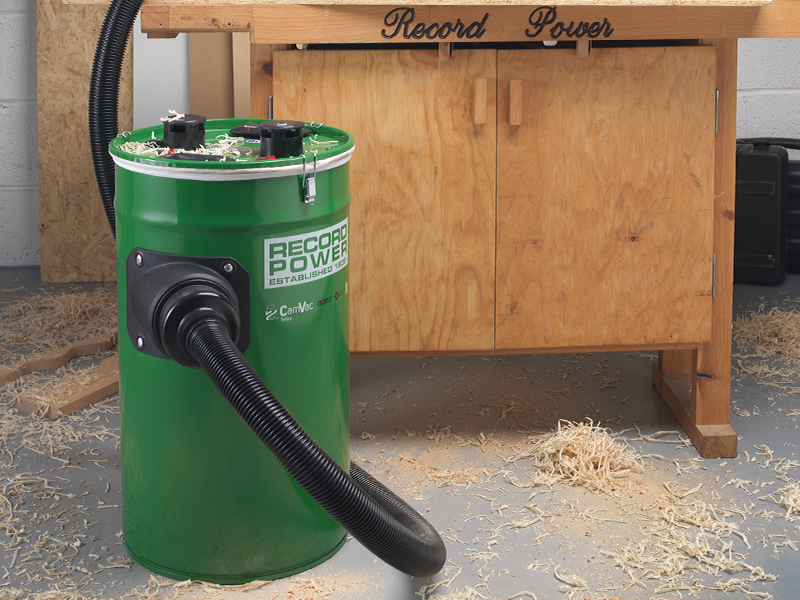
Why this compact, UK-made extractor might be the smartest upgrade for your health, your workflow, and your workshop.
In our dust extraction series, we have explored the science behind filtration, the confusion around airflow, and the critical difference between HVLP and HPLV systems. Now we turn our attention to a primary extraction system that addresses the challenges all of those articles raise: CamVac.
CamVac is a carefully engineered system that offers serious fine dust filtration, strong negative pressure, low maintenance, and practical versatility – all in a compact and modular package. In this article we explore why CamVac might be the right choice for the average workshop – and where it performs best.
1. Serious Power - and Options to Scale
One of CamVac’s most practical strengths is its multi-motor modular design
Models with one, two, or three vacuum motors let you match suction to the task. A single-motor model may be sufficient for one benchtop machine at a time. A twin-motor model provides more sustained performance for longer sessions or heavier applications. A triple-motor model suits demanding use – multiple connections, very long hose runs, or intensive chip-generating operations.
Multi-motor designs also allow motor rotation during extended sessions – running on one motor while another cools – which extends useful working time without performance drops.
Unlike traditional HVLP systems that rely on airflow volume alone, CamVac generates strong negative pressure. This is what makes it effective for fine dust extraction through narrow hoses and fine filters – pressure is what drives air through the system rather than simply pushing volume through.
See: HVLP or HPLV – What Are the Differences and Why Do They Matter?
2. Built-In Cyclonic Action - Less Clogging, More Consistency
CamVac’s inlet creates a cyclonic effect that separates larger debris from the airflow before it reaches the filters.
Incoming material is directed around the inside of the drum, using centrifugal force to separate heavier particles downward into the collection area while finer dust continues toward the filters. The practical results are:
- Filters encounter less large debris – they load more slowly and maintain airflow for longer between cleaning.
- Performance stays more consistent through a session – suction does not drop as quickly as filters begin to load.
- For users who switch between fine sanding and chip-producing operations, the cyclonic separation helps manage the mixed waste load.
Over time, this means fewer filter changes, less maintenance, and more consistent extraction across a session.
3. Filtration Designed Around the Particles That Matter Most
Many extractors claim to trap fine dust. CamVac’s filtration is designed around the particle range that health agencies identify as posing the greatest long-term risk.
PM2.5 – particles smaller than 2.5 microns – is identified by the US EPA, the World Health Organization, and UK government agencies as the most dangerous fraction of airborne particulate matter for long-term respiratory and cardiovascular health. CamVac’s standard filter configuration achieves high capture efficiency in this range as standard.
It is worth understanding what this means in practice. Filter performance is often described as a nominal threshold – the smallest particle size a filter is designed to address. A threshold rating tells you the intended range of the filter, but not the proportion of particles at that size that are actually captured under real operating conditions. For the PM2.5 range, CamVac’s independently tested filter efficiency provides meaningful protection and at a much higher level than many alternatives.
For the full explanation of how filter ratings work and what independent testing reveals about real-world efficiency, see Why Microns Matter.
4. Quieter Than You Might Expect
Vacuum motor systems can run louder than impeller-based chip collectors – but CamVac’s exhaust hose option reduces perceived noise significantly.
Using the exhaust hose to direct motor noise away from the work area, operating levels reduce considerably compared to running without it. For context:
- A 10 dB reduction corresponds to approximately 50% reduction in perceived loudness.
- CamVac can operate at 71 to 74 dB with the exhaust hose fitted – comparable to a dishwasher in the next room.
dB level | Comparable sound | CamVac context |
82 dB | Loud hairdryer / busy road | 3-motor CamVac – full power, no exhaust hose |
74 dB | Shower or loud conversation | 2 or 3-motor CamVac with exhaust hose |
71 dB | Dishwasher in next room | 1-motor CamVac with exhaust hose |
60-65 dB | Normal conversation | With muffler box or external venting |
CamVac noise level | Guidance |
82 dB | Below HSE action levels, but ear protection worth considering for prolonged use in small workshops. |
74 dB | Well below action levels – comfortable for sustained use. |
71 dB | Quiet by dust extractor standards – no hearing protection required at this level alone. |
Note: The figures above relate to CamVac operating noise only. Other machines running simultaneously will raise total noise levels, and hearing protection should always be considered if there is any doubt. Hearing damage is cumulative and often not noticed until it has become significant.
5. Versatile, Compact, and Easy to Integrate
CamVac is designed to adapt to a wide range of workshop setups and can grow with your needs.
- Wall-mounted, floor-standing, or mobile – the range covers a variety of positioning options.
- Compatible with handheld power tools, routers, mitre saws, bandsaws, lathes, and floor-standing machines.
- Accepts both 100mm wide hose and narrower hose configurations – because performance is pressure-driven rather than airflow-dependent, stepped-down connections maintain effective extraction.
- Compact models can be positioned under bench-mounted machines or mounted on the wall, preserving workshop floor space.
- The Defender interceptor range can be added between the machine and the main unit, increasing waste capacity, simplifying disposal, and extending filter life during high-waste sessions.
- A wide range of accessories – hoses, adapters, inlet fittings, floor stands – extends compatibility across tool types and workshop layouts.
- Beyond dust extraction, CamVac’s powerful vacuum motors make it effective for general workshop cleanup – a practical dual-purpose tool.
See: Inlet Size and Reducers – What Really Matters and Why for guidance on connecting CamVac to tools with different outlet sizes.
6. Real-World Performance, Not Just Spec Sheet Numbers
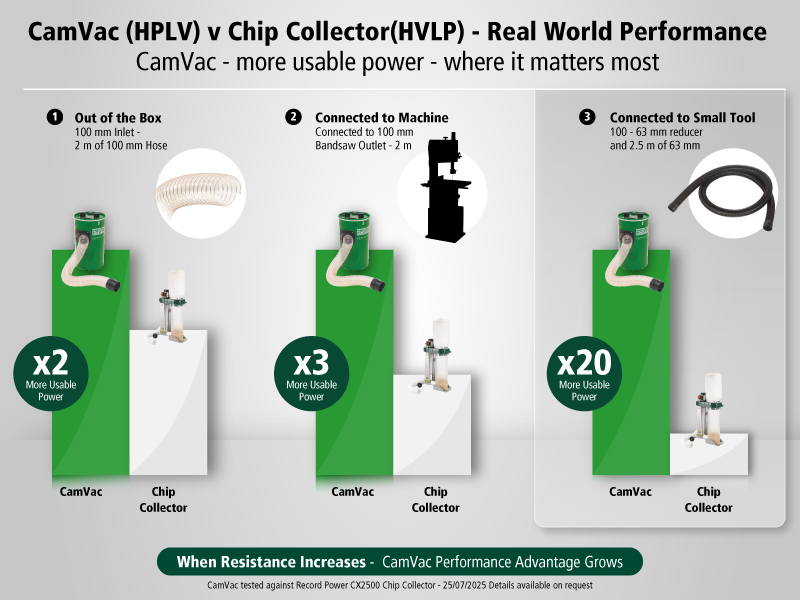
CamVac’s performance advantage over chip collectors is most apparent in the conditions where chip collectors struggle.
Many extractors quote high airflow figures measured under open conditions. CamVac’s static pressure-based design means it maintains more of its performance when the system is actually under load:
- Through fine filters – where low-pressure systems lose significant airflow.
- Across longer hose runs – where static pressure sustains capture at the tool end.
- With small-port tools – where narrow connections would choke a low-pressure system.
The multi-motor approach also helps with sustained performance – spreading the load across motors rather than running a single motor at its limit reduces heat build-up and maintains consistent suction through longer sessions.
See: Airflow – Critical or Confusing? for a full explanation of why static pressure is the more relevant measure for fine dust work.
7. Made in the UK - With Ongoing Development
CamVac has been manufactured in Sheffield since Record Power acquired the brand in 2014, with significant investment in the production facility and product range since then.
Development over that period has included:
- Thermal motor protection added across the range.
- Strengthened internal mountings and structural components.
- Introduction of the bayonet inlet fitting system for more secure hose connections.
- Improved floor stand and wall-mount configurations.
- Higher production standards and improved quality control throughout.
UK manufacture means production is under direct control, supporting both quality consistency and the ability to develop the range in response to user feedback.
8. Value Over Time
CamVac is not the lowest entry price option – but the total cost of ownership compares well against alternatives that require significant upgrades to reach similar fine dust performance.
The comparison is most relevant when set against chip collectors upgraded to improve fine dust performance. Cartridge filter upgrades for chip collectors can cost as much as – or more than – the original machine. Even then, cartridge filters on chip collector systems rarely achieve the PM2.5 efficiency of a purpose-built HPLV vacuum extractor, because the static pressure needed to drive air effectively through fine media is not available in HVLP architecture.
Additional value considerations:
- No costly filter upgrade required to achieve meaningful PM2.5 protection – it is built into the standard specification.
- European-made vacuum motors and UK assembly backed by a five-year guarantee.
- Modular design means the machine can be expanded with additional motors, interceptors, or accessories as workshop needs grow – rather than requiring replacement.
- Significantly more space-efficient than equivalent chip collector setups, because high-pressure filtration does not require large filter surface area.
The most meaningful comparison is not CamVac against a basic chip collector – it is CamVac against a chip collector that has been upgraded to approach similar fine dust performance. At that point, the cost, space, and capability arguments often shift considerably.
What About Compact Power Tool Extractors?
Compact HPLV extractors from premium power tool brands are well-suited to their intended application – but that application is more specific than it can appear.
These machines offer excellent fine filtration and are designed to integrate with specific tool ecosystems, particularly for on-site use and handheld tool applications. For mobile setups and site work, they are a strong choice.
For general workshop use with a mix of stationary machines and handheld tools, their limitations become more relevant:
- Small filters and collection bins clog and fill quickly under machine-generated waste volumes.
- Narrow native inlet diameters are not suited to the 100mm outlets on stationary machines, regardless of adapters fitted upstream.
- Single-motor designs offer limited scalability for extended or multi-machine use.
CamVac and compact power tool extractors are complementary rather than competing: compact extractors are specialist tools for on-site and handheld use; CamVac is a workshop-scale system designed for the full range of extraction needs across fixed and portable machines.
So, Is CamVac the Perfect Extractor?
For many small to medium workshops - particularly those with a mix of machines and tool types - it may be the closest practical answer to that question.
CamVac offers:
- Better fine dust protection than chip collectors – with high efficiency in the PM2.5 range as standard.
- More scalable than compact power tool extractors – motor options, interceptors, and accessories grow with the workshop.
- More versatile than either – equally at home with a palm sander, a lathe, a bandsaw, or a router table.
- Honest about what it does best – and where other solutions may be more appropriate.
CamVac may not be the right choice if:
- Your primary application is continuous heavy planing of wide boards – a dedicated high-volume chip collector may handle that specific load more cost-effectively.
- You need ultra-compact extraction for mobile or on-site use with handheld tools only.
- You already have a large, well-specified fixed HVLP ducted system and do not need fine dust capability beyond what it provides.
Don’t just take our word for it – Hooked on Wood dubbed CamVac “the perfect extractor for the average workshop” in their widely viewed YouTube review.
Ready to Protect Your Lungs and Upgrade Your Extraction?
Contact your local Record Power dealer for more information, current stock availability, and pricing. They can advise on the most appropriate CamVac model and configuration for your tools, space, and budget.
Further Reading
Each article in the dust extraction series covers a specific topic in depth. They are written to stand alone.
Understand the health risks and the science:
> The Dangers of Wood Dust for Woodworkers – The health evidence and why home workshops carry particular risk.
> Why Microns Matter: Understanding Dust Filtration for Woodworkers – What filter ratings actually measure, and what efficiency in the PM2.5 range means in practice.
Understand how extractors work:
> HVLP or HPLV – What Are the Differences and Why Do They Matter?– The extractor type question that determines what dust your machine can actually capture.
> Airflow – Critical or Confusing? – Why CFM figures can be misleading – and what to look for instead.
> Inlet Size and Reducers – What Really Matters and Why – How hose setup affects real-world extraction performance.
Make your decision:
> Dust Extraction Buyer’s Guide – A practical framework for choosing the right system for your workshop.
Related Posts


Discover more...
If you’ve enjoyed reading this guide, why not take a look at some of our blogs?