


CamVac
Knowledge Hub
-

CamVac Series
-

Made in Britain
-

Made in Sheffield
Why Microns Matter: Understanding Dust Filtration for Woodworkers
Micron specifications only protect you if you understand what is being measured — and what is not.
Key Takeaways
If you read nothing else, read these. They are the conclusions of this article — not teasers for what is coming.
Where Different Particle Sizes Go in Your Body
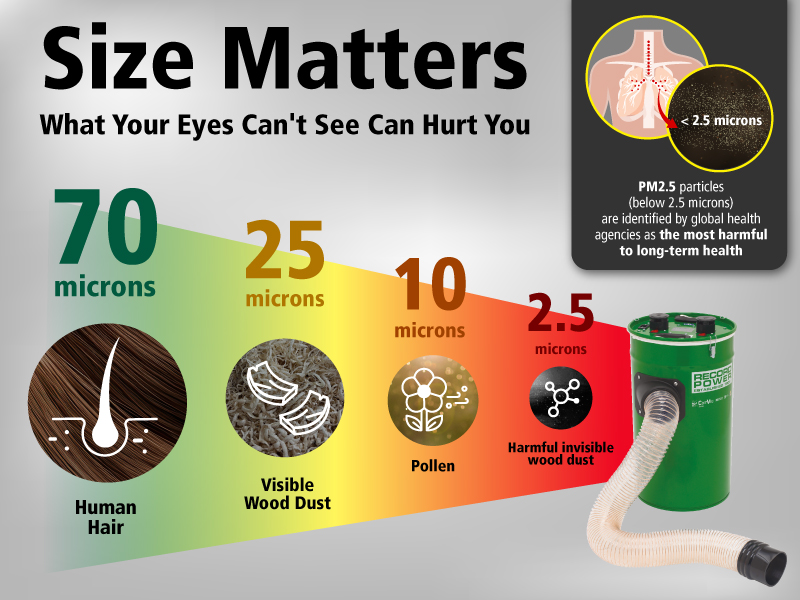
- A micron is one-thousandth of a millimetre. Airborne wood dust particles smaller than approximately 20 microns are invisible to the naked eye — but not harmless.
- Particles between 0.1 and 2.5 microns (PM2.5) present the greatest threat to lung health — small enough to bypass the body’s natural defences, large enough to lodge in deep lung tissue.
- PM2.5 — particles smaller than 2.5 microns — are identified by the US EPA, UK Government Agencies and WHO as the most dangerous fraction of airborne particulate matter for long-term health.
- Filter ratings in the dust extraction industry are often stated as a threshold — the smallest particle size a filter is designed to address. This is not the same as efficiency — the percentage of particles at or near that size that are actually captured in real world use.
- 0.3 microns is the benchmark for HEPA filter testing because it is the hardest particle size for any mechanical filter to capture — the Most Penetrating Particle Size (MPPS) — not because it is necessarily the most dangerous size.
- For practical health protection, what matters most is how efficiently a filter captures particles in the PM2.5 range under real operating conditions — not its nominal threshold rating.
In Brief
A micron is one-thousandth of a millimetre and the difference between a filter that addresses particles at 10 microns and one that addresses them below 2.5 microns is the difference between chip collection and meaningful health protection. The particles most harmful to the lungs fall between 0.1 and 2.5 microns — small enough to bypass the body’s natural defences, large enough to lodge in lung tissue rather than being exhaled. Most traditional extractors exhausting directly through a large material bag offer no meaningful protection in this range at all. Understanding what filter ratings actually measure — and what they do not — is one of the most useful things a woodworker can know when choosing extraction equipment.
What This Article Covers
This article takes around six minutes to read in full. Use the links below to jump to any section.
Key Takeaways
- What Is a Micron? — A reference point for a measurement most of us never encounter directly
- Where Different Particle Sizes Go in Your Body — How particle size determines where dust settles in the respiratory system
- Why the 0.1 to 2.5 Micron Range Matters Most — The size band most strongly associated with long-term lung damage risk
- What Filter Ratings Actually Mean — The difference between a threshold claim, a nominal efficiency figure, and real-world performance
- Why 0.3 Microns Appears on Specifications — The physics behind the benchmark — and why it can be misunderstood
- Real-World Filter Performance — What tested efficiency in the health-critical range actually looks like
- The Concentration Question — What we do not yet know — and why it matters
- Common Questions — The questions we are asked most often
- Honest Limitations of This Article — What this article covers — and what it does not
- Further Reading — The companion articles that go deeper
Key Takeaways
A micron — or micrometre — is one-thousandth of a millimetre: the unit used to describe particles too small to see but significant enough to determine where in the respiratory system dust ends up.
For most of us, particle sizes at this scale are genuinely difficult to visualise. A few reference points help:
- A human hair is typically around 70 microns in diameter — clearly visible to the eye, and a useful reference point.
- Visible airborne wood dust — particles that catch the light or settle as a layer — are generally around 25 microns and above.
- Particles smaller than around 20 microns are invisible to the naked eye under normal workshop conditions.
Common particle sizes for reference:
To help visualise these sizes, the third column shows what each particle would look like if every micron were enlarged to one millimetre — a scale of 1,000 times.
Particle type | Approximate size | At 1,000x scale |
Human hair | Approx. 70 microns | About the width of your palm |
Visible airborne wood dust | Approx. 25 microns and above | About the width of your thumb |
Pollen / PM10 boundary | Approx. 10 microns | About the width of your little fingernail |
Deep-lung wood dust (PM2.5) | 0.1 to 2.5 microns | Smaller than a pinhead |
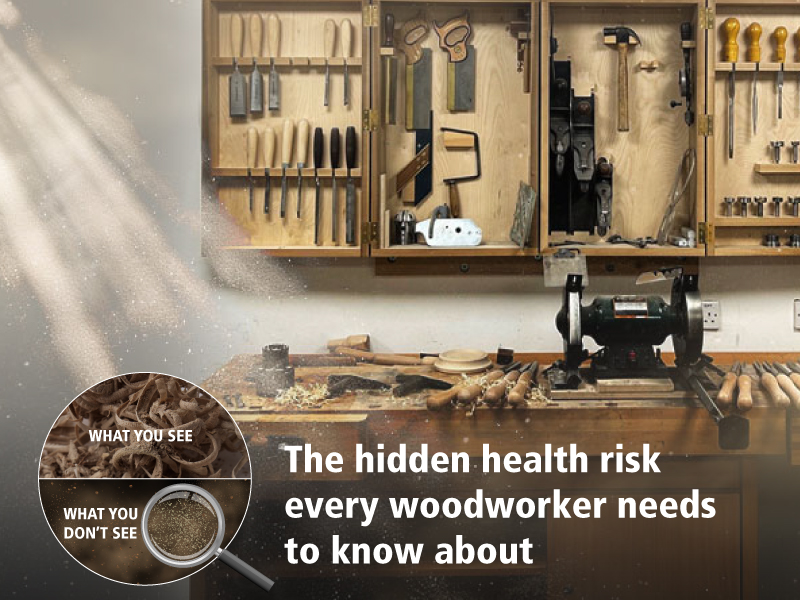
The most dangerous dust in your workshop is the dust you cannot see.
Where Different Particle Sizes Go in Your Body
The health risk of wood dust depends not just on how much you inhale, but on where in the respiratory system particles of different sizes are able to travel.
Larger particles are mostly intercepted before they reach the lungs. The nose, throat, and upper airways act as a first line of filtration — effective for coarser dust, but progressively less so as particle size falls below 10 microns.
Particle size | Where it tends to settle | Health significance |
Above 10 microns | Nose and throat | Generally caught and expelled by the body’s natural defences |
2.5 to 10 microns (PM10) | Upper lungs (bronchi and trachea) | Can cause irritation and inflammation; cleared more slowly than larger particles |
0.1 to 2.5 microns (PM2.5) | Deep lungs (alveoli) | Penetrates to gas exchange tissue; very slow clearance; most strongly associated with long-term damage |
Under 0.1 microns (ultrafine) | May pass through lung tissue into bloodstream | Potential systemic effects; tends to be exhaled more readily than particles just above this size |
US Environmental Protection Agency (EPA):
“Particles less than 10 micrometres in diameter pose the greatest problems, because they can get deep into your lungs, and some may even get into your bloodstream.”
Public Health England:
“Particles larger than 10 µm are mainly deposited in the nose or throat, whereas particles smaller than 10 µm pose the greatest risk because they can be drawn deeper into the lung. The strongest evidence for effects on health is associated with fine particles (PM2.5).”
[Guidance — Health matters: air pollution, published 14 November 2018]
The behaviour of ultrafine particles — those below 0.1 microns — is worth noting because it is counterintuitive. These particles are actually more likely to be exhaled than those in the 0.1 to 2.5 micron range. At very small sizes, random Brownian motion causes particles to collide with airway surfaces rather than depositing deeply in the alveoli. This makes the 0.1 to 2.5 micron range the zone of greatest long-term concern: particles large enough to deposit in the deepest tissue, small enough to bypass the body’s natural defences, and removed so slowly that cumulative exposure builds over years of workshop use.
Why the 0.1 to 2.5 Micron Range Matters Most
PM2.5 — particles smaller than 2.5 microns — is identified by the US EPA, the World Health Organization and Public Health England as the most dangerous fraction of airborne particulate matter for long-term respiratory and cardiovascular health.
This is not a woodworking-specific finding. It comes from decades of population-level research into air quality, respiratory disease, and cardiovascular mortality. The mechanisms are well understood: fine particles penetrate to the alveoli and deposit on tissue that is not designed to clear them efficiently. Over time, cumulative exposure is linked to chronic respiratory conditions, reduced lung function, and elevated cancer risk.
Wood dust falls within this range. Operations that generate the finest particles — sanding (particularly fine-grit sanding of hardwoods), routing, and turning — produce significant proportions in the PM2.5 fraction. Large-chip operations like planing tend to produce coarser material dominated by PM10 and above, though fine dust is present in those operations too.
California Air Resources Board (citing WHO Global Burden of Disease data):
“Of all the common air pollutants, PM2.5 is associated with the greatest proportion of adverse health effects related to air pollution, both in the United States and worldwide.”
The particles settling visibly on your bench are not the ones posing the greatest long-term risk. The particles you cannot see — those below 2.5 microns — are the ones that reach deepest into lung tissue, are removed most slowly, and are associated most strongly with long-term illness.
What Filter Ratings Actually Mean
Filter ratings in the dust extraction industry are most commonly stated as threshold figures — the smallest particle size a filter is designed to address. Understanding what that means in practice — and what it does not tell you — is essential before comparing specifications.
A threshold rating has two limitations that are worth understanding separately.
Threshold is not efficiency
A filter described as capturing particles “down to 1 micron” or “down to 0.5 microns” tells you the lower end of the particle size range the filter is designed to address. It does not tell you what percentage of particles at or near that size are actually captured. That figure — the efficiency — can vary enormously between products that carry the same threshold claim and will depend not only on the filter itself but the speed of the air in the system, the pressure in the system and other elements which are necessary to move and capture the dust.
Nominal efficiency figures are measured under ideal conditions
Where manufacturers do provide an efficiency figure alongside a threshold rating, that figure is often from the filter manufacturer measured on clean, unloaded filter media in controlled laboratory conditions. Real-world operating conditions are different in an important way: the airflow and pressure needed to move dust-laden air through ducting and into the extractor exerts force on particles as they approach the filter. Particles that would be captured at low velocity can be driven through filter media under the higher-pressure differential of actual operation — much as a person barely able to squeeze through a narrow gap might be pulled through with sufficient force from the other side.
The result is that the efficiency you can reasonably expect in real workshop use may be lower than the nominal figure stated for that filter — and the degree of difference varies by system design, airflow rate, dust loading, and filter condition.
How common filter types compare, and what that means for PM2.5 protection:
The filter rating a system can effectively use depends not only on the filter media but on the system architecture — specifically whether the extractor generates sufficient static pressure to drive airflow through finer filter media without unacceptable performance loss. High-volume, low-pressure (HVLP) chip collectors rely on airflow volume and cannot sustain fine filtration; high-pressure, low-volume (HPLV) vacuum-based extractors use static pressure to maintain airflow through much finer filters.
Extraction system | Typical filter type | Typical threshold | PM2.5 protection |
Chip collector / HVLP extractor | Woven cloth or felt exhaust bag | Around 30 microns | None meaningful — PM2.5 passes freely. Low system pressure means finer filters would choke airflow |
HVLP extractor with upgraded cartridge | Cartridge filter (exhaust-side) | Around 1–5 microns | Partial — addresses some PM10 but limited PM2.5 protection; efficiency variable under load |
HPLV vacuum extractor (sub-micron filter) | Fine filter media, inlet-side | Below 1 micron | Meaningful — high static pressure maintains airflow through fine media; tested efficiency determines actual PM2.5 capture |
FFP3 respirator or PAPR (correctly worn) | Certified filter medium | 99%+ at 0.3 microns | Excellent personal protection during direct exposure — an efficiency figure, not a threshold |
A high airflow (HVLP) Chip Collector and a sub-micron high pressure (HPLV) Vacuum Extractor may both be described as “dust extractors” in marketing materials — but they operate in entirely different parts of the particle size range. The particles most associated with long-term respiratory illness sit in the range that standard chip collectors do not meaningfully address at all.
Why 0.3 Microns Appears on Specifications
The 0.3 micron benchmark that appears on HEPA filter specifications and on many dust extractor claims is not there because it is the most dangerous particle size. It is there because it is the hardest particle size for a mechanical filter to capture.
Filters are tested at 0.3 microns because this size corresponds to the Most Penetrating Particle Size (MPPS) — the point at which mechanical filtration is least effective. The US EPA describes this directly:
US Environmental Protection Agency:
“The diameter specification of 0.3 microns corresponds to the worst case; the most penetrating particle size (MPPS). Particles that are larger or smaller are trapped with even higher efficiency.”
The reason 0.3 microns is hardest to capture comes from the interaction of two separate physical mechanisms:
- For particles above around 0.4 microns, the dominant capture mechanism is impaction. Particles of this size have sufficient mass that they cannot follow the curved path of airflow around a filter fibre — they continue in a straight line and collide with the fibre instead. The larger the particle, the more effectively this works.
- For particles below around 0.1 to 0.2 microns, diffusion dominates. At very small sizes, random collisions with air molecules cause particles to deviate erratically from the airflow — this Brownian motion increases the likelihood of contact with filter fibres. Counterintuitively, smaller particles are captured more readily by this mechanism than slightly larger ones.
- In the range around 0.3 microns, neither mechanism operates at full effectiveness. Particles here are too small to rely on impaction and too large for strong diffusion effects. This is the zone of minimum efficiency for any mechanical fibrous filter.
NIOSH confirms the underlying mechanism: impaction and interception are the dominant collection mechanisms for particles above 0.2 microns; diffusion dominates below 0.2 microns. The practical consequence is that a filter’s performance at 0.3 microns is its worst-case figure — it will capture both larger and smaller particles more efficiently than it captures particles right at the MPPS.
This has a significant implication: a filter with modest efficiency at 0.3 microns is not necessarily performing poorly across the board. At 2.5 microns — the PM2.5 boundary that research identifies as the primary health threshold — efficiency will be substantially higher, because 2.5 microns is well above the MPPS where impaction becomes increasingly effective. The 0.3 micron figure describes the hardest case, not the typical case.
A note on electrostatic filter claims
Some filters achieve high efficiency at 0.3 microns by applying an electrostatic charge to the filter media. This can produce impressive new-filter performance figures — including HEPA-level claims at 0.3 microns — because the electrostatic attraction supplements the mechanical capture mechanisms across all particle sizes, including within the MPPS zone.
The limitation is that electrostatic charge dissipates with particle loading and use. The mechanical substrate of the filter — the fibrous structure that remains once the charge has degraded — performs at a level consistent with its physical construction. Filters that show very high efficiency at 0.3 microns when new may therefore provide less protection over their working life than the initial specification suggests. The meaningful question is not only what efficiency a filter achieves when new, but what the underlying mechanical performance is once the electrostatic enhancement has dissipated.
Real-World Filter Performance
Particles below 2.5 microns are widely recognised as posing the greatest risk to long-term respiratory health. Tested filter efficiency in this range, under real operating conditions, is a more meaningful measure of protection than any nominal threshold rating.
It is common practice across the dust extraction industry to describe filter performance as a nominal threshold — the smallest particle size a filter is designed to address. As discussed, this does not describe efficiency, and even where efficiency figures are provided they are typically measured under clean, unloaded conditions that may not reflect performance in real use.
We have had our current filter specification independently tested in a UK laboratory, measuring fractional capture efficiency across a range of particle sizes under operating conditions. The results in the health-critical size range are as follows:
Particle size range | Measured capture efficiency |
2.2 to 3.0 microns | 100% |
1.6 to 2.2 microns | 99% |
1.3 to 1.6 microns | 95% |
1.0 to 1.3 microns | 90% |
0.7 to 1.0 microns | 78% |
0.55 to 0.7 microns | 53% |
0.4 to 0.55 microns | 32% |
0.3 to 0.4 microns | 14% |
These figures show that the filter captures the substantial majority of particles in the size range most strongly associated with deep lung deposition and long-term health risk. Performance at the PM2.5 boundary — 2.5 microns — is 99 to 100%. Efficiency rises steeply through the range above 0.55 microns, consistent with moving away from the Most Penetrating Particle Size zone where impaction becomes increasingly effective.
Performance is lower in the 0.3 to 0.55 micron range. As explained in the section above, this reflects the physical behaviour of mechanical fibrous filters at and around the MPPS — a characteristic of all mechanical filters of this construction type, not a specific product limitation. It is also the range where electrostatic filter claims are least reliable over time, for the same physical reasons.
This also demonstrates the clear gap between performance in use compared to nominal performance — our nominal filter specification is 95% capture at 0.3 microns — but that does not reflect performance under the pressure and airflow of real operating use shown above — although the protection in the most dangerous PM2.5 area is significant and meaningful.
To put this in context against the alternatives:
- A standard bag filter operating at around 30 microns captures none of the particles in the table above in any meaningful quantity.
- A cartridge filter at 1 to 5 microns may capture some particles in the upper part of this range, with performance variable at and below 1 micron and potentially lower under load.
- A sub-micron vacuum extractor filter of the type tested here provides 99 to 100% capture at the PM2.5 boundary and meaningful protection across the PM1 range — substantially better than either bag or cartridge alternatives for the particle sizes that research identifies as most harmful.
The case for sub-micron vacuum extraction rests not on nominal threshold claims but on tested efficiency in the range that matters most for health. Compared to bag and cartridge alternatives, a well-designed sub-micron filter provides protection in the particle size band where the science is most consistent about long-term risk.
The Concentration Question
Knowing that a filter captures a high percentage of particles in a given size range is only part of the picture. What also matters — and is less well documented for typical home workshop use — is the actual concentration of fine particles that woodworking operations generate.
Filtration efficiency tells you what proportion of particles passing through the filter are captured. It does not tell you what concentration of fine particles is present in the workshop air during and after a session, nor how quickly that concentration returns to safe background levels once work stops and extraction is switched off.
These are meaningful questions. The health risk from wood dust is a product of both particle size and the concentration and duration of exposure over time. A well-specified filter operating in a workshop generating relatively low concentrations of fine particles may provide excellent protection. The same filter in a workshop generating very high concentrations may face a harder task.
For typical home workshop use — intermittent sessions mixing machine use, hand tools, and sanding — reliable particle concentration data is not widely available in the published literature. Industrial exposure studies exist but describe sustained professional use rather than the intermittent, mixed-activity sessions typical of the serious home woodworker.
What we do know from occupational research is that sanding consistently generates the highest concentrations of fine particles, particularly fine-grit sanding of hardwoods. Routing and turning also produce significant fine dust fractions. Large-chip operations like planing tend to generate coarser material, though fine dust is present in all woodworking operations to varying degrees.
This is an area where real-time air quality monitoring in the workshop — measuring actual fine particle concentrations during different operations — would provide insights that filter specification sheets alone cannot deliver. The right tool for reducing residual airborne fine dust after a session is an ambient air filter, not a primary extractor: primary extractors are designed for source capture at the point of dust production, while ambient air filters are designed to cycle and clean the room air. We will update this article as more relevant data becomes available for typical home workshop conditions.
It is important to think of dust control as a system. Primary dust extraction does the heavy lifting to capture as much dust as possible from source and prevent it reaching the workshop at all. But its effectiveness will be determined not only by the filter specifications but also by the effectiveness of the dust extraction ports and options on any given tool or machine and how well sealed the system is. An air filter is a useful and effective tool to help clean ambient dust in workshop air over time. And Personal Protective Equipment or PPE (like half mask respirators or powered respirators) are highly recommended when processing timbers especially associated with high risk or when cleaning out extractors and filters.
The right question is not only “what does my filter capture?” but “what is the concentration of fine particles in my workshop, and how effectively is my whole extraction and ventilation setup managing it?” Both questions matter for a complete picture of your real-world protection.
Common Questions
These are the questions we are asked most often.
Does a higher micron number mean better filtration?
No — a higher micron number means the filter addresses larger particles, which is generally less protective for health. A filter rated to 0.5 microns targets finer particles than one rated to 5 microns. When comparing filters, a lower threshold number indicates finer particle coverage — though as discussed above, threshold alone does not tell you about efficiency or real-world performance.
I have a material bag filter on the exhaust of my dust collector. Is it providing adequate fine dust protection?
Almost certainly not for the particle sizes most associated with long-term lung damage. Whatever filter type you use — woven cloth, felt, paper, cartridge, or otherwise — the minimum meaningful standard for health protection against the particles research identifies as most harmful is coverage rated to 2.5 microns or below. Standard bag filters typically operate at around 30 microns in entry-level machines, which provides no meaningful protection in the PM2.5 range. Even where improved filter options exist for bag-type collectors, it is worth asking whether the manufacturer can provide efficiency data (not just a threshold rating) and whether that data reflects performance under real operating conditions rather than clean-filter laboratory tests. If the manufacturer cannot provide tested efficiency data, that itself is informative. And if you are considering a filter that claims high efficiency through electrostatic media, it is reasonable to ask what the underlying mechanical performance is once that charge has degraded — because that is your baseline protection over the filter’s working life.
My extractor claims to filter to 0.5 microns. What does that actually mean?
It means the filter is designed to address particles down to that threshold size — which is useful directional information. A filter rated to 0.5 microns will generally perform significantly better than one rated to 1, 5, or 10 microns, even without knowing the specific efficiency at each size. Threshold ratings are not useless — they tell you the intended operating range of the filter and allow meaningful comparisons between products at the same end of the market. The limitation is that the threshold alone does not tell you what proportion of particles at 0.5 microns are captured in real use. Without efficiency data measured under operating conditions, the threshold is the best available guide but not a complete picture.
Is HEPA filtration the right standard to look for in a dust extractor?
A genuine HEPA-rated filter does provide excellent protection in the PM2.5 range. Because efficiency increases above the Most Penetrating Particle Size, a filter that genuinely achieves 99% or better at 0.3 microns will typically achieve 99 to 100% at 2.5 microns — where the health science identifies the greatest long-term risk. The important questions are whether the HEPA performance is based on the mechanical substrate of the filter (which remains consistent over its working life) or on electrostatic enhancement (which degrades with use and loading), and whether the whole system can sustain that performance in practice. A genuine HEPA filter in an underpowered system with insufficient airflow will load quickly, causing pressure drop and reduced capture efficiency long before the filter reaches the end of its rated life. For dust extraction, the filter specification and the system around it need to be considered together: the right balance of pressure, airflow, filter surface area, and filter quality determines real-world performance, not the filter rating alone.
Should I run my extractor after I finish working to clear the air?
A primary extractor — the type connected directly to a machine or tool — is designed for source capture: removing dust at the point of production. Running it unconnected after work stops may have some effect on room air, but this is not what it is designed for and its effectiveness in this role depends heavily on where it is positioned relative to where airborne dust has accumulated. The right tool for managing residual fine dust in workshop air after work stops is an ambient air filter — a ceiling or wall-mounted unit that draws room air through a filter and returns it cleaned. Fine particles can remain suspended in workshop air for hours after machining stops, and an ambient air filter running during and after a session is the most effective way to reduce that residual concentration. Some ambient air filter systems can be set on timers to continue running after you leave the workshop, which is particularly useful for fine sanding dust that settles very slowly.
What is M or H Class and does my extractor need to be this specification?
M and H class are certification standards for industrial vacuum cleaners used for cleaning settled dust from surfaces, floors, and machinery after machining has stopped. They require the whole machine – not just the filter – to meet specified leakage limits, along with a mandatory airflow alarm.
CamVac is designed and used as a primary extraction system – connected directly to machines and tools to capture dust at source as it is produced. The relevant measure for that purpose is fractional efficiency across the particle sizes most associated with health risk, not whole-machine leakage under static test conditions. These are different tests measuring different things. If you are a professional employer or self-employed woodworker working commercially, you should ensure your dust control setup meets your local regulatory requirements. In the UK this means COSHH, PUWER, and HSE guidance including HSE Information Sheet WIS23. In EU markets, equivalent national implementations of the relevant EU directives apply. Requirements vary by jurisdiction and we recommend checking with your local health and safety authority or a qualified occupational hygienist for your specific situation.
If you are a home woodworker using CamVac in your own workshop, COSHH does not apply to you and the relevant question is what meaningful protection your system can provide you against fine dust in the particle size range most associated with long-term health risk – PM2.5.
Honest Limitations of This Article
This article covers what micron ratings mean, how particles behave in the respiratory system, and what filter performance data does and does not tell you. It does not cover how to choose an extractor.
The purpose here is to give you a clear and accurate foundation for understanding filtration — not to guide product selection. Questions about extractor types, airflow and pressure, hose setup, and which machine might suit your workshop are covered in the companion articles listed below.
This article does not cover filtration standards for non-wood materials — MDF, composites, laminates, and finishing products each carry their own risk profiles and in some cases have specific regulatory guidance. It does not cover respirator selection in depth, or occupational exposure limits. For regulated workplace guidance in the UK, the HSE’s COSHH documentation is the appropriate reference.
The concentration question raised above remains genuinely open for typical home workshop use. We intend to do further research and testing in this area. This article will be updated as better data becomes available.
Further Reading
Each of the following articles covers a specific aspect of dust extraction in depth. They are written to stand alone.
Understand the risk:
-> The Dangers of Wood Dust for Woodworkers — The health risks of wood dust and why home workshops carry particular exposure risk.
Understand how extractors work:
-> HVLP or HPLV — What Are the Differences and Why Do They Matter? — Why system type determines how effectively a filter can be used in practice.
-> Airflow — Critical or Confusing? — Why CFM figures can be misleading and what to look for instead.
-> Inlet Size and Reducers — What Really Matters and Why — How hose setup affects the particles your extractor can capture at the tool.
The complete guide:
-> Dust Extraction Buyer’s Guide — A decision framework for choosing the right system for your workshop.
Related Posts

Airflow
Critical or Confusing?

Discover more...
If you’ve enjoyed reading this guide, why not take a look at some of our blogs?